

▌The budget fits into the plan. Time, usually, does not.
In marketing, we talk a lot about budgets—about audiences, channels, goals, and KPIs. But I think we sometimes forget about a resource that’s just as important: time.
I’ve been thinking about this lately, following a discussion about a project that has a very clear sales goal to be met by the end of the year. It’s just that, for various reasons, the project’s launch keeps getting postponed.
And I find it interesting that, more often than not, when this happens, the goals remain the same. The budget remains the same. Only the time available to achieve them shrinks, without anyone reassessing what is still realistic.
When you cut the budget, everyone understands that the results will change. When you cut back on time, though, often no one considers the same thing. In this article, I’ve compiled what studies and industry data say about how long online marketing actually takes, how long it takes to see results on each channel (Google Ads, Facebook Ads, SEO, branding), and how you can set goals that take the timeline into account—not just the budget.
In a nutshell: How long does it take to see results from marketing?
- Paid ads (Facebook Ads, Google Ads): The learning phase lasts from a few days to a few weeks. Realistically, consistent results appear after 2–4 months of preparation, testing, and optimization.
- SEO: It takes between 4 and 12 months to see noticeable results in traffic and leads.
- Branding: Nearly 60% of the profit generated by advertising is realized after the first three months, over a period of up to two years.
- B2B: Only about 5% of customers are “in the market” at any given time, so the cycle is even longer.
Why Do We Almost Always Underestimate How Long a Marketing Project Will Take?
It’s not just a marketing issue. Professor Bent Flyvbjerg of Oxford analyzed a database of 16,000 projects—ranging from construction to IT—for his book *How Big Things Get Done* (2023). His conclusion:
- Only 8.5% of projects are completed both on budget and on time;
- Only 0.5% deliver on time, within budget, and with the promised benefits;
- In other words, 91.5% exceed the budget, the deadline, or both.
Flyvbjerg attributes this to two trends: optimism (we believe things will go faster than they usually do) and what he calls “strategic misrepresentation”: overly optimistic plans designed to get approval. His remedy is simple to state but difficult to implement: think slowly, act quickly, and leave room for experimentation, because things rarely go right the first time.
In marketing, the consequence is predictable. The initial plan calls for a launch on a specific date. The launch is delayed by two months. The sales target remains the same as of December 31. And the period for learning, testing, and adjusting disappears from the schedule—not because it’s no longer needed, but because no one explicitly included it in the plan.
▌How long does online promotion actually take on each channel?
Even channels considered “fast-paced” have a learning curve outlined in their own rules. And channels that build something sustainable are measured in months, not weeks.
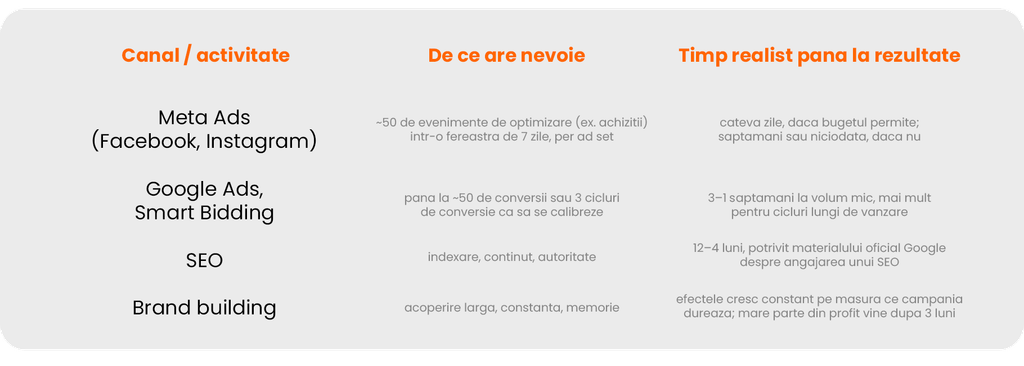
There are three things worth noting from this table.
The learning phase in Facebook Ads and Google Ads resets
On Meta (Facebook and Instagram), significant changes to the budget, targeting, or ad creation restart the process. On Google, changing the bidding strategy has the same effect, which is why Google Ads campaigns need a few weeks of stability after every major change. If the launch is delayed and then everything is crammed into a few weeks with daily adjustments, the algorithms don’t have time to learn.
A small budget means it takes longer to see results
Here’s a simple example: if an acquisition costs you 40 euros in ad spend and Meta needs ~50 acquisitions per week to complete the learning phase, you’ll need ~2,000 euros per week for that ad set. With a smaller budget, the learning phase takes longer. Less money basically means more time. That’s why, when planning Facebook Ads campaigns, we first calculate the minimum budget needed to exit the learning phase and only then set the timeline.
How long does it take to see SEO results?
SEO is the best example of unrealistic expectations. A HigherVisibility study shows that 68.8% of small and medium-sized business owners expect results in less than three months, while Google itself estimates a timeframe of four months to a year. An SEO optimization project should therefore be planned on a quarterly basis, not weekly: the first signs (indexing, impressions in Search Console) appear sooner, but consistent traffic and leads come after a few months.
▌In B2B, the process takes even longer
Research by Professor John Dawes (Ehrenberg-Bass Institute), published by the LinkedIn B2B Institute in 2021, gave rise to the 95:5 rule: at any given time, only ~5% of B2B buyers are “in the market.” The remaining 95% will not make a purchase for months or even years.
If a company switches providers on average once every five years, only ~20% of potential customers enter the market in a given year. Over the course of a month, we’re talking about ~2%. This means that a campaign launched in October with a sales target for December is, in reality, targeting a very small slice of the market. The authors explicitly state that this rule should teach us to set realistic goals.
- Sales activation (promotions, performance, “buy now”) yields immediate results, but the effects fade quickly.
- Brand building yields modest growth in the short term, but the greatest gains in the long term.
This is where the famous 60:40 rule comes from: approximately 60% of the budget goes to branding, and 40% to activation. Less often cited, but just as important to our topic, is another observation: the number of business outcomes increases steadily as the campaign runs. The longer it runs, the more time it has to produce results.
Most of the profit comes after the first three months
The Profit Ability 2 study (Thinkbox, 2024), conducted in partnership with Ebiquity, EssenceMediacom, Gain Theory, Mindshare, and Wavemaker, analyzed 1.8 billion pounds invested in media in the United Kingdom, across 141 brands and 14 categories.
- In the first 13 weeks, every pound invested in advertising yields an average profit of 1.87 pounds.
- Over a period of up to two years, the yield rises to 4.11 pounds.
- According to the7stars, nearly 60% of advertising revenue is generated between Week 14 and Month 24.
In other words, if you evaluate a campaign based solely on the first three months, you’re seeing less than half of its impact. The authors also note that, in the FMCG (Fast-Moving Consumer Goods) sector, returns only become apparent during the sustained-effect period, and in the automotive sector, long-term effects are nearly four times greater than short-term ones.
▌What Large Companies Have Learned About Time
Adidas: The Cost of Measuring Everything in the Short Term
In 2019, at the EffWeek conference in London, Simon Peel, then global media director at Adidas, publicly acknowledged that the company had invested too much in digital and performance marketing. According to WARC, econometric modeling showed that the brand generated 65% of sales (in retail, wholesale, and e-commerce), even though it received a smaller share of the investment.
The German trade press (W&V) reported that Adidas had historically allocated about 77% to performance and 23% to branding. Peel’s explanation was, essentially, time pressure: the company was trying to grow sales very quickly and was focusing on the wrong metrics—the short-term ones.
Airbnb: When You Have Time to Build, You Can Cut Back on “Fast”
During the pandemic, Airbnb cut back on its performance marketing almost entirely and found that traffic remained virtually unchanged. According to Campaign, total marketing spending fell from $1.14 billion in 2019 to $482 million in 2020, with the majority of the cuts coming from performance marketing.
In 2021, the company made a permanent shift: less focus on performance, more on branding and PR, with its first global branding campaign in five years. Two years later, Airbnb reported its most profitable fourth quarter in history, and ~90% of its traffic came from direct or organic sources. The lesson for our topic: Airbnb was able to do this because it had ten years of brand-building behind it. It was the time invested earlier that allowed it to stop “buying” every visit.
Dove: 20 Years of the Same Idea
The “Real Beauty” campaign began in 2004 and continues today in various forms. The figures vary depending on the source, but several reports mention that Dove’s sales grew from ~$2.5 billion to ~$4 billion in the campaign’s early years. In 2023, nearly 20 years after its launch, Unilever announced that Dove had achieved the highest organic growth of the past decade, reaching ~6 billion euros.
This case is often cited precisely because it illustrates the combination described by Binet and Field: a very long-term brand strategy, supported in parallel by short-term product-focused communication.
▌How to Set Realistic, Time-Bound Marketing Goals
A business objective should have four components, not three: budget, audience, desired outcome, and actual execution time. Not the calendar date, but the number of weeks the campaign is actually running.
How long does a new campaign last: Break down the time into phases, not just the budget
For a new project, a realistic timeline looks something like this (the durations are approximate and depend on the channel, budget, and sales cycle):
- Preparation (2–4 weeks). Tracking, pixels, conversions, landing pages, assets. Any error here delays everything that follows.
- Learning and Testing (3–6 weeks). Algorithms collect data; you test messages, audiences, and offers. The results are unreliable and should not be considered final.
- Optimization (1–2 months). Keep what works, cut what doesn’t, and gradually increase the budget.
- Scaling. Only here does it make sense to evaluate the cost per acquisition and sales volume relative to the target.
If the project starts two months late, the right question isn’t “How do we catch up?” but “What stage will we be at by the deadline?” If the answer is “still in the learning phase,” the sales target needs to be revisited.
What do you do when the start is delayed?
- Recalculate your goal based on the actual weeks of the campaign, not the initial time frame. A ROAS calculator helps you quickly see what revenue is realistic given your remaining budget and time.
- You explicitly determine what will change: the objective, the deadline, or the budget. One of them has to change.
- Break down the metrics by phase: in the first few weeks, track key metrics (CTR, cost per lead, conversion rate), not just sales.
- Take advantage of the lead-up period: tracking, creative work, audience building, and SEO content can all begin before launch.
- You avoid cramming: spending more money in less time does not proportionally shorten the learning process and may increase costs.
- Set a long-term goal (brand, brand awareness, customer base) on paper, so you don’t judge everything based solely on the current quarter.
A Simple Formula for Goals
Instead of “X sales by December 31,” try: “X sales in the first N weeks after launch, with an M-week learning period during which we’ll track metrics A and B.” If the launch is delayed, the goal is pushed back accordingly, or it becomes clear what needs to be renegotiated.
▌Frequently Asked Questions About How Long Online Promotion Takes
It depends on the channel. Paid ads can generate the first conversions within a few days, but consistent results typically appear after 2–4 months of preparation, testing, and optimization. SEO takes 4–12 months, and branding has the greatest impact after the first three months, with results lasting up to two years.
Meta exits the learning phase after approximately 50 optimization events within a 7-day window, per ad set. With a sufficient budget, this can take a few days; with a small budget, a few weeks. Significant changes to the budget, targeting, or creative restart the process.
Smart Bidding typically requires up to ~50 conversions or 3 conversion cycles to calibrate, which is about 1–3 weeks for low-volume campaigns and longer for campaigns with long sales cycles. Changing the bidding strategy resets the learning period.
There is no guaranteed timeframe. Google estimates that an SEO specialist needs four months to a year to implement improvements and see results. For keywords with low competition, this can happen more quickly; for highly competitive keywords, it takes longer.
At least until it moves past the learning phase and enters a period of optimization: realistically, 2–3 months for a new campaign. In the first few weeks, you monitor metrics (CTR, cost per lead, conversion rate), not just sales.
The most common causes are a budget that is too small relative to the number of conversions the algorithm requires, frequent changes that reset the learning process, incomplete tracking, and a long sales cycle. In B2B, only ~5% of buyers are in the market at any given time.
Sure, sometimes you can see results very quickly. But the data shows that, most of the time, you don’t. Algorithms take weeks to learn, SEO takes months, and more than half of the profit generated by advertising comes after the first three months. When someone asks, “How long will it take to see results from online promotion?”, the honest answer starts with “It depends on what stage you’re at.”
So the next time a project is postponed, it’s worth asking a simple question: if we’ve wasted time, what else changes? Because, just like a budget, time is a resource. Except that, unlike a budget, you can’t add more of it at the end of the year.
Sources
- Binet, L. & Field, P., *The Long and the Short of It* (IPA, 2013): summary by Alex Murrell, IPA
- Mark Ritson on Binet & Field: Marketing Week, via Marketing Science
- Thinkbox, Profit Ability 2 (2024): Thinkbox, the7stars
- Flyvbjerg, B. & Gardner, D., *How Big Things Get Done* (2023): Goodreads
- Rule 95:5, LinkedIn B2B Institute & Ehrenberg-Bass: Marketing Week
- Google Ads, Learning Period: Google Ads Help
- Meta, learning phase: Cometly
- SEO, 4–12 months: Piranha Digital on the Google Guide, HigherVisibility
- Adidas: WARC, W&V
- Airbnb: Campaign, Marketing Week
- Sources: Kantar, Markhub24