


▌What the Data Shows About Buyers (2023–2026)
Black Friday 2026 in Romania is generating the highest purchase intent in recent years: 70% of Romanians aged 18–55 say they will make a purchase, according to the MKOR study published in October 2026. In 2023 and 2024, the percentage was 57%.
This year’s shoppers, however, come with a prepared list, a set budget, and a clear expectation: a discount they can verify. We’ve compiled data from the last four years on what Romanians are buying, how trust in discounts has changed, and what the latest data on Black Friday ads reveals.
I’ve written before about Black Friday marketing strategies and promoting a store on Black Friday. This time, we’re starting with the customer: what the numbers tell us and how they shape the campaign.Black Friday 2026, in a nutshell:
- Paid ads (Facebook Ads, Google Ads): The learning phase lasts from a few days to a few weeks. Realistically, consistent results appear after 2–4 months of preparation, testing, and optimization.
- SEO: It takes between 4 and 12 months to see noticeable results in traffic and leads.
- Branding: Nearly 60% of the profit generated by advertising is realized after the first three months, over a period of up to two years.
- B2B: Only about 5% of customers are “in the market” at any given time, so the cycle is even longer.
Why Do We Almost Always Underestimate How Long a Marketing Project Will Take?
It’s not just a marketing issue. Professor Bent Flyvbjerg of Oxford analyzed a database of 16,000 projects—ranging from construction to IT—for his book *How Big Things Get Done* (2023). His conclusion:
- 70% of Romanians aged 18–55 plan to make a purchase, compared with 57% in 2023.
- 84% of them make their list in advance, on average about 4 weeks ahead of time.
- 86% already have a budget, averaging about 2,100 lei.
- 36% of undecided shoppers would buy if they could easily compare the discounted price with the previous one.
- 60% will shop exclusively online, compared with 47% in 2025.
Interest in Black Friday is growing, and sales must be secured
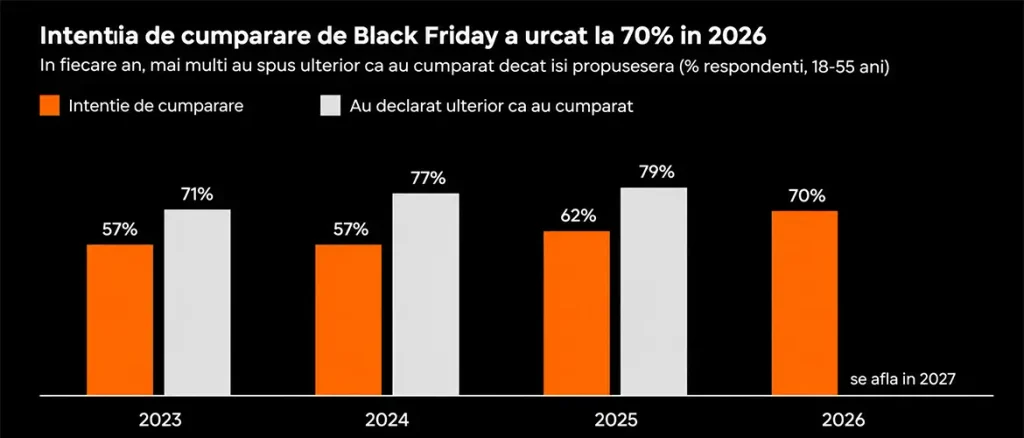
Source: MKOR, Black Friday Trends 2023–2026. Purchase intent is measured before the event; actual purchases are reported in the following year’s survey.
Purchase intent reached 70% in 2026, 13 percentage points higher than in 2023. The increase was not continuous: in 2022, it stood at 62%, fell to 57% in 2023 amid economic pessimism, and did not recover until 2025.
Each year, those who later reported having made a purchase exceeded their stated intention by 14–20 points. Respondents vary from year to year, so this is a trend at the sample level. MKOR interprets the 70% figure from 2026 as more of a minimum.
However, we are talking about stated intentions, not guaranteed sales. The 2026 survey included 1,000 respondents aged 18 to 55, with a margin of error of ±3.1%.
For an entrepreneur, this interest represents an opportunity. But people who want to shop on Black Friday haven’t automatically decided to buy from you. The key question is: What specific reason do you give the customer to choose you from among all the offers they see?
▌The shopping list existed before the campaign
Most shoppers know what they want before they even see the first Black Friday ad. In 2026, 84% of shoppers will make a list in advance, on average 4.1 weeks ahead of time. Millennials start the earliest, nearly five weeks in advance.
This behavior is nothing new. In 2024, MKOR noted that Romanians were preparing their shopping lists about a month before November 1. In 2025, 93% of those planning to shop had a list, which they had started 3–4 weeks earlier.
The main reason remained the same across all four editions of the study: products that consumers had been eyeing for a long time, hoping to find at a better price. In 2025, this reason was cited by 53% of shoppers. The second reason: Christmas gifts bought early (31%).
The impulse hasn’t completely disappeared. Anyone who has a home appliance on their list can add a fragrance they’ve discovered along the way to their cart. But the big decision is usually made before the campaign begins.
What this means for a store: the product must be added to the customer’s list in October, not on the day of the sale. Wish lists, saved items, and items left in the cart already show you what your customers are waiting to buy at a discount.
▌What Do Romanians Buy on Black Friday?
Home appliances and electronics remain at the top of the list every year, but the shopping basket has become more diverse. In 2026, shoppers will target an average of 3.5 categories of products or services.
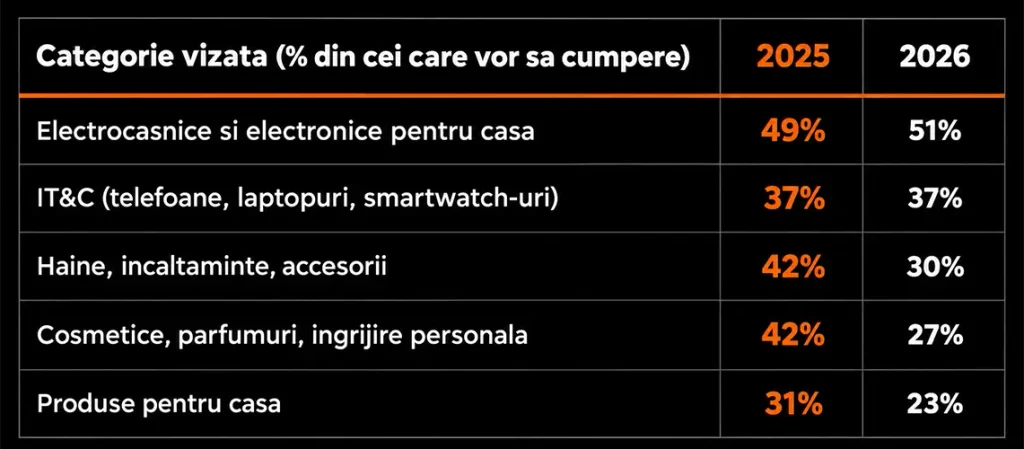
Source: MKOR, Black Friday 2025 and Black Friday 2026. Multiple responses were allowed, so the total exceeds 100%. Home appliances accounted for 58% in 2024.
Fashion and beauty had a very strong year in 2025, when purchase intent nearly doubled. In 2026, they fell back slightly, but remain relevant in certain segments.
▌List of women and list of men
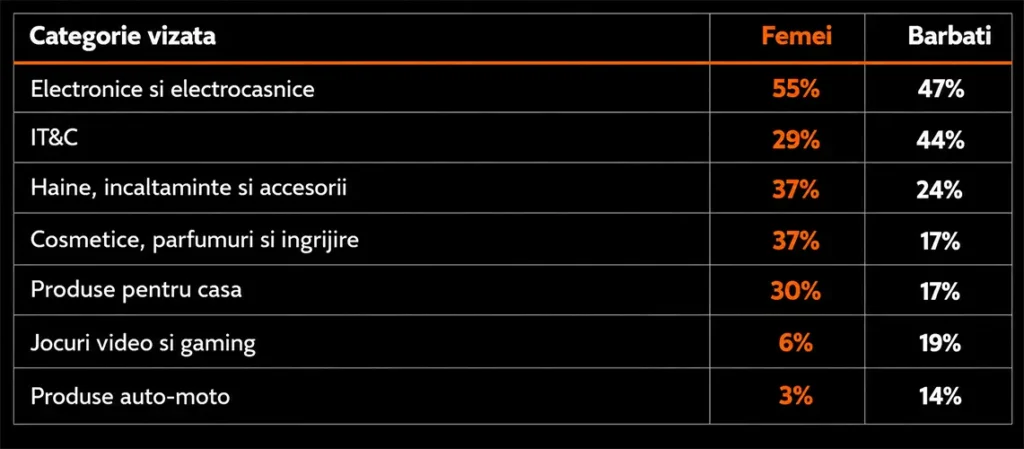
Purchase intent is nearly the same: 70% among women and 71% among men. However, their shopping lists differ, according to data presented by Economedia:
▌Differences Between Generations
A business objective should have four components, not three: budget, audience, desired outcome, and actual execution time. Generation Z has the highest purchase intent (78%), followed by Millennials (69%) and Generation X (66%). The largest increase comes from Generation X: from 52% in 2025 to 66% in 2026.
Young people are more interested in clothing and accessories (38%) and video games (24%). Home appliances appear more frequently on the lists of Generation X (55%) and Millennials (53%). Toys and children’s items appear twice as often among Millennials (20%).
These market insights show you where to look. What your customers search for, save, and buy tells you which offer to choose.
▌How Perceptions of Black Friday Have Changed in Romania
Consumer confidence in Black Friday has gone through a period of skepticism, and now shoppers are demanding discounts they can verify. Interest and skepticism have coexisted every year.
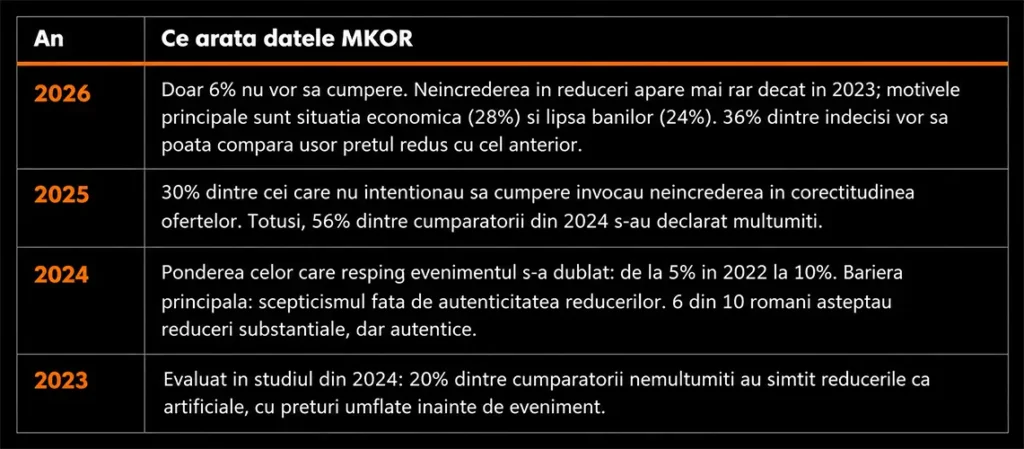
Source: MKOR, Black Friday studies for 2024, 2025, and 2026.
At the same time, the group of undecided voters has shrunk each year: 34% in 2023, 31% in 2024, 28% in 2025, and 24% in 2026. More and more people have formed an opinion.
▌What dissatisfies those who have purchased it
Of those who made a purchase in 2025, 59% were satisfied and 10% were dissatisfied. Those who were dissatisfied cited, first and foremost, a smaller discount than they expected (60%) and out-of-stock items (46%). The sample size is small, so the figures are approximate.
When asked what they would like to see changed in 2026, 77% called for substantial or genuine discounts, while 33% called for sufficient inventory.
The discount must be easy to verify
For an undecided customer, a big discount isn’t enough if they can’t see it at a glance. The European Omnibus Rules, which also apply in Romania, require that the previously displayed price be the lowest price charged in the last 30 days.
For us, this is the key change in marketing: trust is built on concrete information. How much does the customer save? What products are included in the offer? Are they in stock? How much does shipping cost, and when will the order arrive?
A high percentage on a banner catches the eye. The product page must live up to that promise.
▌Black Friday Spending and Where Romanians Shop
More people want to buy, but their budgets aren’t increasing. The average reported budget for 2026 is approximately 2,100 lei, compared to 2,046 lei in 2025 and 2,179 lei in 2024. The wording of the question changed in 2026, so this comparison is for reference only.
The amount has remained between 2,000 and 2,200 lei for three years, while prices have risen. In the MKOR Consumer Sentiment 2026 study, 75% of Romanians say that prices have risen significantly. The same amount of money probably buys fewer products now.
The budget is determined based on available funds (50%, compared to 71% in 2023), the prices of the items on the list (43%), the economic context (25%), and the option to pay in installments (25%).
Payment data confirms the trend. According to NETOPIA Payments, the average card payment on Black Friday 2025 was 400 lei, 60% above the annual average. The total volume processed increased by 19% compared to 2024, and more than half of the payments were made after Black Friday.
What this means for a store: structure your offerings around the final amount the customer pays. It’s worth testing a useful bundle, an accessible threshold for free shipping, a monthly payment amount displayed on the page, or a clear selection organized by price ranges, along with percentage-based discounts.
Online Returns to the Top Spot
In 2026, 60% of those who want to make a purchase will do so exclusively online, compared to 47% in 2025. Hybrid shopping will drop to 29%, and in-store-only shopping to 8%.
The biggest change is among Generation Z: 57% will shop exclusively online, compared to 35% in 2025, when most combined online shopping with in-store shopping.
Those who shop online or via hybrid channels choose marketplaces (70%), retailer or manufacturer websites (61%), and mobile apps (41%). They learn about deals primarily from retailers (74%), followed by social media (57%) and advertisements (45%). AI assistants will first appear in 2026 and will be used by 6% of those who seek information.
▌What the Data Says About Black Friday Ads
Frequently refreshed ads and promotional messages delivered the best results on Black Friday and Cyber Monday 2025, according to an AppLovin analysis presented by Marketing Dive. The analysis uses checkout and revenue data from e-commerce advertisers in the AppLovin ecosystem.
- New materials matter. Advertisers who launched new creatives nearly every week in November had a seven-day ROAS that was 23% higher than those who updated their creatives once or twice. In November 2025, 63% of advertisers refreshed their creatives in at least three weeks of the month.
- Recent designs are more efficient. Compared to those older than 60 days, the materials uploaded in November had a ROAS that was 20% higher on the first interaction and a cost per acquisition that was 19% lower.
- The offer brings in revenue; the product lays the groundwork. Product-related messages accounted for 58.2% of the content, but only 37.8% of the delivered budget. Promotional messages generated 64.2% of the revenue attributed over a seven-day period.
- Short videos performed the best. Compared to the June–September period, short-form video ads saw an 83% increase in ROAS for the first interaction. For ads lasting 16–29 seconds, the increase dropped to 39%, and for those longer than 30 seconds, it fell to 24%.
- The ending of the commercial matters. Interactive end cards increased ROAS by 35% compared to the baseline period, while static end cards decreased it by 11%.
These are results from a single platform; they are not a forecast for Romania. A correlation does not prove that changing ads frequently, on its own, produces better results.
▌How to Link Data to the Client’s Calendar
Data from MKOR and AppLovin support this from two angles: the decision is made in advance, and the offer confirms it. The practical approach is a series of messages, not a single ad:
- 4–5 weeks in advance: product presentation, when the customer is making their list. Demos, reviews, comparisons.
- Launch of the offer: the previous price and the actual savings, right in front of you. Short video, clear message.
- As we wrap up: remaining inventory and the deadline, for those who are still undecided.
It’s worth checking out the benefits, demos, reviews, and price. Simply changing the banner’s color doesn’t answer a new question from the customer.
▌What Should a Business Do to Prepare for Black Friday 2026?
Based on this data, we recommend five priorities:
- Products chosen for a reason. Use search results, sales, and wish lists to offer discounts on items customers are already looking at.
- Pre-launch announcement. Send it to the client about four weeks in advance, when they’re making their list, and let them know exactly when the campaign starts.
- Verifiable discounts. Display the original price next to the discounted price, starting on the first day. Avoid ads that say “up to 70% off” that apply to only a few products.
- A simple route to the order. Check your mobile experience, payment, inventory, and delivery information.
- An assessment that includes profitability. Track your margin, acquisition cost, returns, and completed orders, along with revenue and ROAS.
Black Friday brings together promotions, marketing, and operations. Advertising can draw an interested customer to the website; their decision depends on what they find there.
At re7consulting, this is where we start our planning: with the products customers want, an offering the business can support, and an experience that lives up to the promise made in the ad.
▌Frequently Asked Questions About Black Friday 2026 in Romania
According to the MKOR study, 70% of Romanians aged 18–55 intend to make a purchase, the highest level since 2023.
Approximately 2,100 lei, close to 2,046 lei in 2025 and 2,179 lei in 2024.
Home appliances and electronics (51%), followed by IT & C (37%), clothing and accessories (30%), and cosmetics (27%).
Distrust has decreased compared to 2023, but expectations have risen: 77% of shoppers in 2025 will expect substantial or genuine discounts, and 36% of undecided shoppers want to be able to easily check the previous price.
On average, about four weeks in advance: 84% of those who want to buy make a list ahead of time.